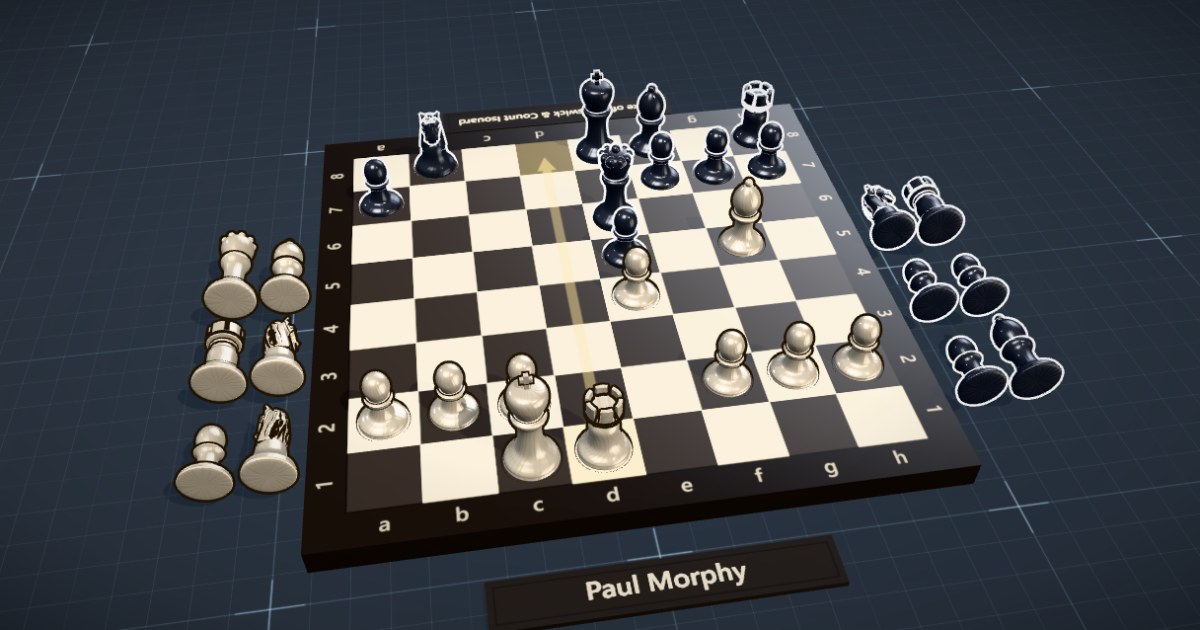
Chess at the opera
Paul Morphy came to Europe in 1858 as the best player in America and left it as the best player in the world. In Paris he was invited to the Italian Opera House by the Duke of Brunswick, who had a box overlooking the stage. The Duke and his friend Count Isouard wanted a game, and they played it together, consulting on every move, while the opera went on below them.
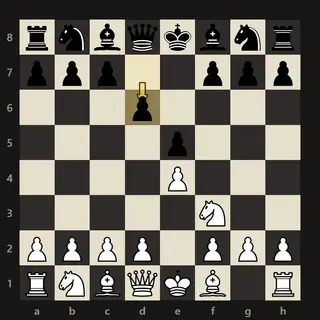
The performance is usually given as Bellini’s Norma, and the story goes that Morphy played quickly because he wanted to watch it. Whatever his reasons, the game took seventeen moves. The Duke and the Count answered his 1.e4 with 1…e5, and after 2.Nf3 chose 2…d6, the solid defence named after the eighteenth-century French master François-André Danican Philidor.
A pin that wasn’t
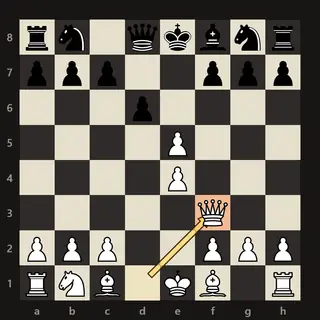
After 3.d4 Black played 3…Bg4, pinning the knight on f3 to the queen behind it. It looks like good, active chess. Morphy showed it wasn’t. With 4.dxe5 he simply took a pawn, and Black could not take back, because the bishop on g4 would then have been left hanging.
So Black gave up the bishop: 4…Bxf3, 5.Qxf3, and only then 5…dxe5. Count the result. White has a queen and a pawn in the centre, and the queen is already looking at f7. Black has no pieces developed at all, and has swapped off one of the two bishops that might have defended the light squares.
Two pieces against f7
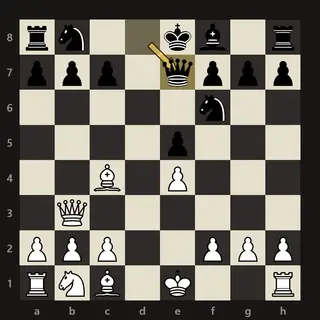
The square f7 is the weak point in Black’s camp at the start of every game, because only the king defends it. Morphy aimed everything at it. 6.Bc4 added a bishop to the queen. Black blocked the queen with 6…Nf6, so Morphy simply moved her to the other diagonal that ends on f7: 7.Qb3.
Now two white pieces hit f7, and Black had to cover it with the only piece that could: 7…Qe7. It works, but it is a sorry sight. Seven moves in, Black has one knight out and a queen doing a pawn’s job, standing in front of the bishop that should have been coming out.
Every piece in the game
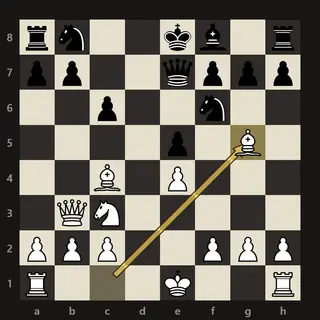
Morphy could have taken a free pawn on b7 with his queen. He didn’t. Instead he played 8.Nc3 and then 9.Bg5. This is the part of the game teachers care about most. By move nine every white piece except the rooks is developed, and every one of them points at Black’s king. Black has a knight and a queen out, and the queen is busy defending.
Black tried to gain time with 9…b5, attacking the bishop on c4. It opened the one line White still needed.
Paying the bill
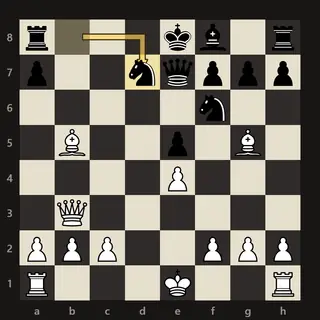
Instead of retreating, Morphy gave up a knight for two pawns: 10.Nxb5, 10…cxb5, 11.Bxb5+. It is less a gamble than an invoice. Black had spent nine moves developing almost nothing, and the bill had come due.
The check left Black one way out: put a knight on d7 with 11…Nbd7. That knight is now pinned against its own king by the bishop on b5. From here on, the whole game is about that one square.
One more attacker than defender
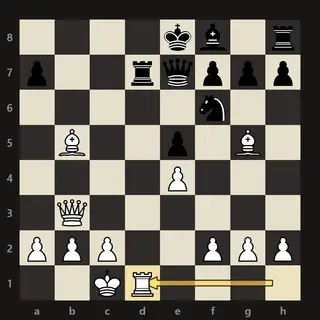
Morphy castled long, 12.O-O-O, and his rook landed straight on the d-file, attacking the pinned knight. Black added a defender with 12…Rd8. Morphy took anyway, 13.Rxd7, giving a rook for a knight, and after 13…Rxd7 he brought up the other rook: 14.Rd1.
That is the method in one sentence: bring one more piece to the square than your opponent can defend it with. Black found a second guard with 14…Qe6, and for a moment d7 was held.
A queen for one square
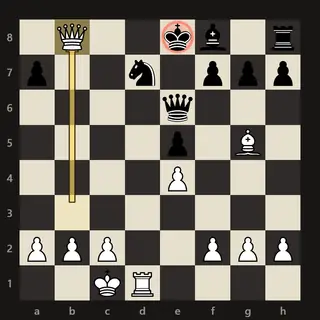
Morphy took on d7 with the bishop and check, 15.Bxd7+, and Black took back with the knight, 15…Nxd7. Then came the famous move: 16.Qb8+. The queen is simply given away, with check.
There is only one piece that can take her, the knight on d7, and taking her means leaving d7. Black had no choice. Every other reply was mate at once.
Mate, and why it is still taught
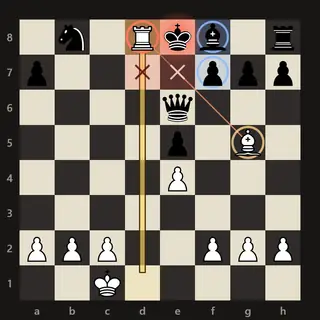
After 16…Nxb8, 17.Rd8# was checkmate. The rook could not be taken, because the bishop on g5, out since move nine, covered d8 once Black’s queen had left e7. Morphy finished with just a rook and a bishop, having given away his queen, a knight, a rook and a bishop to get there.
Unlike the Immortal Game, there is no question about how this one ended, and every white move follows from a plain idea. It is the clearest demonstration of three ideas every beginner is told: develop your pieces, get your king safe, and don’t move the same piece twice without a reason. Black broke all three, and Morphy punished each one.
Every move above is a link that opens the 3D board at that position. For the whole game with a note on each key move, see The Opera Game, move by move.